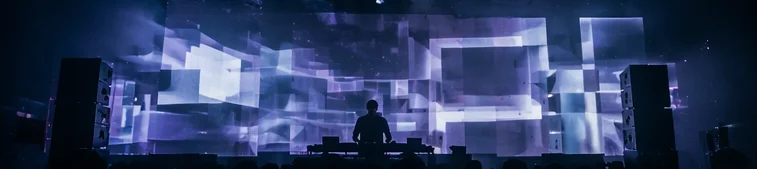
One night, in order
-
Load-in and setup (2–3 hours before doors)
- Success check
- Image is on the screen, with the intended colour and resolution.
-
Doors and the early hours
- Success check
- Visuals survive the house lights without shouting over the room.
-
DJ changeovers
- Success check
- The look moved when the music moved.
-
Peak time
- Success check
- The visual peak and the musical peak are not out of phase.
-
Close and load-out
- Success check
- Every borrowed cable and adapter is accounted for.
What is under their hands
- Clip selection
- A bank of prepared material, and the constant choice of what goes up now. Sources range from self-made to purchased to free libraries to generative work rendered on the spot. This is where a VJ's personality shows most.
- Layer compositing
- Two to four layers blended with modes like add, screen, or difference. A single clip played straight is rare — the recognisably "VJ" look comes from the stacking.
- Effects and parameters
- Blur, hue rotation, feedback, glitch. Most are mapped to sliders or knobs and pushed in real time against the music.
- Audio reactivity
- Binding visual parameters to level or frequency bands so parts of the image move on their own. Nobody can hand-drive everything, so how much is delegated to audio and how much stays manual becomes a personal signature.
- Watching the output
- The preview on the laptop and the image on the wall never look the same. Turning around to check what the room is actually seeing is part of the loop.
There is less talking to the DJ than you would think
Across a whole night, a VJ and a DJ may exchange very few words. If there was a quick alignment beforehand about the mood, the rest is done by listening. In many rooms the booth and the VJ position are far enough apart that conversation is not even possible.
So what a VJ synchronises to is not a person — it is the sound in the room. Genre, tempo, density, where the track breaks: every input arrives through the ears, usually from the floor mix rather than headphones.
Seeing that clearly also explains why driving visuals from song recognition and audio analysis is such a natural idea. The input a VJ works from is literally "the music that is playing," so whatever part of that a machine can read, it can be handed.
Where a live VJ fits — and where they do not
- Fits: strongly curated events
- When the point is to build an artist's world visually and make the whole room part of the show, a live VJ's range is the whole value. It assumes budget and prep time exist.
- Fits: long nights that need an arc
- Over six hours, having a human read the room and push the visuals up and down is worth a lot. No machine can conclude "tonight's crowd is subdued."
- Does not fit: ordinary nightly trade
- Booking a live VJ every night for a DJ bar or lounge essentially never pencils out. The result is the familiar one: a monitor playing YouTube or generic background video.
- Does not fit: nights where budget went to sound
- When the booking budget is spent on the music, the VJ slot is the first thing cut. Wanting visuals but being unable to staff them is a common position.
What about the nights without one
Nights with a live VJ are a small slice of nights with a DJ. On the large majority, either something unrelated is playing on a monitor or nothing is on at all — and as a floor experience, that gap is obvious.
Automated VJ exists to narrow it. Recognise the track, switch the visuals, let the audio drive movement: it hands the "picking" and "timing" halves of the job to a machine and either keeps the "intensity" half with a person or accepts losing it.
It is not a replacement. With budget and a concept, a live VJ has vastly more range. But against the reality that you cannot book one every night, it produces something better than an empty screen.
Frequently asked questions
Does a live VJ know the setlist in advance?
Usually not. DJs select on the fly, so the VJ listens and decides in the same moment. Advance sharing happens mainly on built shows and artist stages.
Where does VJ material come from?
Self-made work, paid stock libraries, free libraries, and generative pieces written in code or shaders — the mix is personal. Playing commercial music videos or films straight is avoided in professional work for rights reasons.
Is a live VJ standing there all night?
Broadly yes. DJs rotate through slots; the VJ generally runs open to close, so the shift is several times longer.
Do people come to see the VJ?
A few do, especially at audiovisual-led events. On an ordinary club night, though, visuals work best as something the room feels without consciously noticing.
How is automated VJ different from live VJ?
Whether the picking and the timing are done by a machine or a person. Automated VJ cannot pace the room, but it runs every night at low cost. The automated VJ guide covers the trade-off in detail.