Three things the word "VJ" means
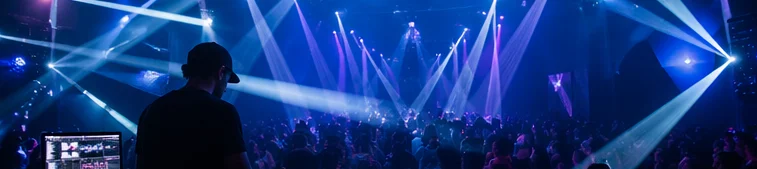
First, the person. A performer mixing visuals live to match a DJ set, or an audiovisual (AV) artist releasing work as a body of art. Internationally notable examples include Daito Manabe (Rhizomatiks, founded in Tokyo in 2006), Nonotak Studio (Noemi Schipfer and Takami Nakamoto, Paris, 2011), and United Visual Artists (UVA, London, 2003; long-running collaborator with Massive Attack).
Second, the software. A small cluster of tools has defined professional VJing for decades: Resolume (Netherlands), TouchDesigner (Derivative, Canada), MadMapper (Garage Cube, Switzerland), VDMX (VIDVOX, USA), and more recently the browser-native Hydra (Olivia Jack, 2017).
Third, the operating mode. "Live VJ," "automated VJ," and "unattended VJ" are different ways of running visuals. Automated VJ — rule- or recognition-driven, browser-based tools like autovj.club included — is a newer category for venues that cannot staff a live VJ every night, and is best understood as a complement to, not a replacement for, live performance.
The main categories
- Live VJ (hands on the controller)
- Picks and mixes visuals in the moment, reading the room and the DJ. Resolume or TouchDesigner driven. Plays best in showcase sets where the VJ is part of the attraction.
- Audiovisual (AV) artist
- Composes both audio and visuals as a coherent work. Ryoji Ikeda, Ryoichi Kurokawa, Alva Noto with Ryuichi Sakamoto. Lives in festivals, galleries, and major stages more than on dance floors.
- Automated VJ (rules or song recognition)
- No operator required on site. Visuals switch with tempo, genre, or track ID. Browser-based systems like autovj.club sit here. Good fit for bars, lounges, side floors.
- Unattended VJ (the outcome, not the tool)
- Describes the operating state — no one actively mixing — rather than a specific technology. Often achieved by deploying an automated VJ system.
Where VJs actually work
Clubs, live houses, and galleries in big cities are the usual habitat. Berghain (Berlin), fabric (London), WOMB and LIQUIDROOM (Tokyo) are representative venues where VJs — house VJs or touring guests — take the visual shift. Smaller bars and side rooms almost always run a mix of "VJ nights" and "no-VJ nights", which is where automated VJ is earning a place.
The other home of VJ culture is the dedicated festival: MUTEK (founded Montreal, 2000; now Tokyo, Barcelona, Mexico City), Sónar+D (Barcelona; Sónar itself since 1994), Mapping Festival (Geneva, 2005). For anyone serious about the field, one of these festivals in person is worth more than a year of reading.
Frequently asked questions about VJing
What does VJ stand for?
VJ stands for Visual Jockey. Where a DJ selects and blends music, a VJ selects, layers, and changes visuals in time with the music. Depending on context the term can also refer to the software or to an operating mode such as "automated VJ".
What is the difference between a VJ and a DJ?
A DJ handles the audio; a VJ handles the visuals. In most venues the VJ mixes visuals to match the DJ's set, so sound and image form a single space.
What do you need to start VJing?
At minimum a computer, VJ software, a monitor or projector, and an HDMI cable. Browser-based automated VJ tools let you try it with no software install. See the VJ Gear Basics guide for concrete setups.
How is automated VJ different from live VJ?
A live VJ mixes visuals by hand on site. Automated VJ switches visuals automatically based on song recognition or rules — a category aimed at bars and lounges that cannot staff a VJ every night.