The rise of Shenzhen LED manufacturers
Through the 2000s, large LED displays were dominated by Japanese makers (Sharp, Mitsubishi, Panasonic) and US stalwarts like Daktronics — their market was stadium scoreboards, racetracks, and Times Square. Unit prices were out of reach for any VJ use case.
Then Shenzhen took over. Leyard (1995), Absen (2001), Unilumin (2004, later parent to 30+ group companies), and ROE Visual (founded September 2006, now a wholly-owned Unilumin subsidiary) scaled manufacturing and vertical integration enough to drop prices across the event-rental tier.
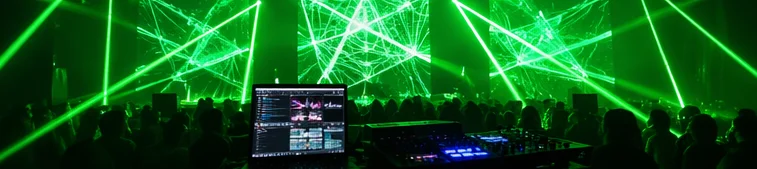
Pixel pitch also kept shrinking. The outdoor-billboard standard P10 (10 mm, viewing distance 15–30 m) gave way in the 2010s to the P3.9 event workhorse, and by the 2020s fine-pitch P1.5 / P1.2 / P0.9 LED panels were showing up in indoor venues and directly behind DJ booths. Micro LED has reached P0.4.
Pitch vs use case
- P10 (outdoor billboards)
- Viewing distance 15–30 m, brightness 6,000–8,000 nit. The class that covers Shibuya Scramble's big outdoor LED. Dominant through the late 2000s and 2010s.
- P3.9 (event workhorse)
- Viewing distance from 4 m. The default for stage backdrops, trade-show booths, and concert LED walls. Took over in the late 2010s.
- P2.6–P1.9 (indoor premium)
- Conference rooms, premium retail, viewing from 2.5 m. In the 2020s it also started landing in DJ booths as a close-range monitor.
- P1.5 / P1.2 / P0.9 (fine pitch)
- High-end indoor, 2020s. COB (Chip on Board) mounting raised contrast and durability. Ranges from Sphere-scale installations down to the LED directly behind a DJ booth.
Prices now (2024–2026)
Industry trackers (Statista, AVIXA-adjacent research) put LED component prices on an 8–12% annual decline through the 2020s. A 2025 snapshot: indoor LED walls run around US$1,000–3,000 / m², outdoor walls US$2,000–5,000 / m² (weatherproofing and high-brightness drive up the outdoor end). Overall market range is roughly US$800–2,500 / m².
On the ground, the more concrete shift is that Alibaba-sourced P3 LED panels in 2 m × 1 m form landed around US$2,000–3,500 from 2023 onwards — simultaneously with 55" 4K TVs falling to the ¥50,000–70,000 band — and both trends poured into bar signage and small-venue setups at the same time.
Landmark cases behind the spread
- Sphere Las Vegas (opened 2023-09-29, US$2.3B)
- 16,000 × 16,000 interior LED (~268M pixels); 580,000 sq ft exterior LED. U2's "U2:UV Achtung Baby Live at Sphere" was the opening run. Not a VJ venue in the traditional sense — but a clear case of "the room itself becomes the visual."
- Shibuya Scramble "Cross Vision" (June 2014)
- Additional Hit Vision LCD screens joined the existing big-monitor cluster. The pattern continued with the 3D calico-cat billboard at "Cross Shinjuku Vision" (July 2021) — urban signage increasingly used in a VJ-like way.
- Resolume adopts pixel mapping as standard
- From version 6 (2017 onward), Resolume's Advanced Output made fixture-based pixel mapping a default feature. The year VJ software officially expected LED walls plus multi-screen setups.
- disguise (originally d3 Technologies)
- Spun out of London's United Visual Artists (UVA, founded 2003) in May 2010 as d3 Technologies, building on the LED + media-server workflow UVA had developed on Massive Attack's 100th Window tour (2003–). Rebranded to "disguise" at LDI 2017. Created the category of large-LED-centric media servers.
Economics feeds straight into operation
"LED got cheap" is not really the end of the sentence. It means "small venues now already have a monitor." A 55" 4K TV behind a bar counter, a 2 m × 1 m LED panel newly installed in a side floor, a fine-pitch LED behind a DJ booth — none of these were bought to play video in 2015, but by the mid-2020s they were present by default.
That is what makes a browser-based automated VJ like autovj.club viable in small rooms: the "there is already a screen" precondition is quietly satisfied. Reading modern VJ culture through economics lands cleaner than reading it through tooling alone.